What Orca Slicer needs from the source file
Orca Slicer can be part of simple or advanced print workflows. The better source format depends on whether you need only geometry or richer project context.

Compare STL and 3MF for Orca Slicer workflows, including color planning, project handoff, and slicer verification.
Last updated 2026-09-30
Step 1
Import model
Step 2
Plan colors
Step 3
Export 3MF
Step 4
Open in Orca Slicer
Step 5
Verify print setup
Browse recommendation pages matched to this topic, then use PrintNext to connect the model, printer, filament, cost, and finished result.
Articulated and flexi prints
Find articulated and flexi 3D print recommendations that are fun to print, easy to share, and realistic for your printer and filament setup.
Dragon print ideas
Discover dragon 3D print recommendations matched to printer fit, filament planning, color needs, and real PrintNext workflow context.
Useful and practical prints
Discover functional 3D print recommendations for organizers, holders, clips, brackets, printer accessories, repair parts, and practical projects.
Orca Slicer can be part of simple or advanced print workflows. The better source format depends on whether you need only geometry or richer project context.
STL is enough for one-color models where Orca Slicer will handle the printer profile, filament choices, supports, and slicing setup.
3MF is better when color assignments, material intent, or previous project context should travel with the model.
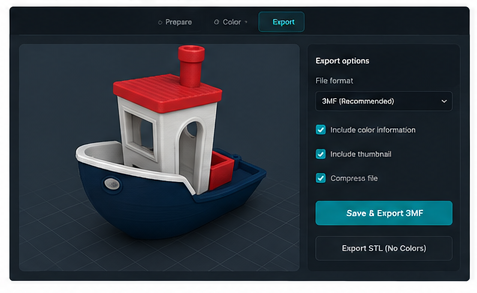
Plan colors in Color Studio, export 3MF, open the file in Orca Slicer, and verify color/material mapping before slicing.
Use STL to move a shape into a fresh OrcaSlicer project. Use 3MF when retaining a compatible project or color plan is the goal. The difference matters most when transferring between applications: opening the container does not guarantee that every application-specific setting is interpreted.
When testing a new printer profile, a plain STL can make the baseline easier to understand. When revisiting a completed multicolor design, a compatible saved project avoids rebuilding the entire color plan. Choose the file according to the stage of work rather than assuming the larger package is always better.
Use the symptom to choose the next check. Change one variable at a time and keep the original file or settings so you can compare the result.
| What you notice | What to check next |
|---|---|
| Paint is present but unexpected slots appear | Review material assignments and remove accidental duplicates only after checking their purpose. |
| The model is a different size | Check the source dimensions and import units. |
| An old project will not reopen cleanly | Preserve it and check version compatibility before saving over it. |
First-party workflow evidence
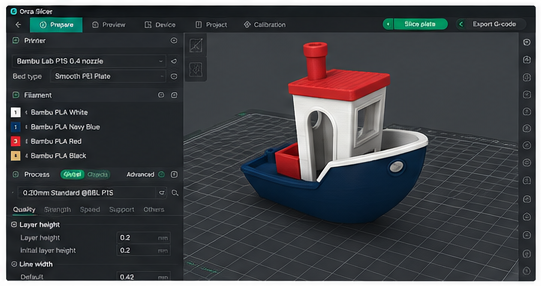
The exported model should retain the intended colored regions, but the slicer remains the authority for printer profile, filament slots, supports, scale, and final print settings. This example shows the PrintNext result after opening it in OrcaSlicer.
Color Studio
Use AI or manual tools to color STL models, match real filament, and export a slicer-ready multicolor 3MF.
FAQ
Use STL for simple geometry. Use 3MF when color or project data matters.
Yes, but always verify assignments and printer setup inside the slicer before printing.
PrintNext can help with color planning and 3MF handoff before final slicer verification.
Check scale, colors, material mapping, supports, printer profile, and estimated filament use.
Your next step
Open Color Studio to add color automatically or by hand, then export a multicolor 3MF and verify it in your slicer.
Find models that fit your printer, filament, and workflow.
Color STL models with AI or manual tools and export a slicer-ready multicolor 3MF.
Keep model files, notes, revisions, and print plans together.
Track filament colors, materials, and remaining spool amounts.
Explore approved models and real PrintNext creations.
These pages connect the same workflow from file format decisions to color planning, inventory, and print cost.
Slicer Workflows
Learn how to paint STL models in Orca Slicer, assign filaments, save a multicolor 3MF, fix missing colors, and check your sliced print before printing.
Format & Workflow
Learn how to prepare multi-color 3D printing models, assign colors, choose the right file formats, and export color-ready files for Bambu Studio, Orca Slicer, and PrusaSlicer.
Format & Workflow
Compare STL and 3MF for geometry, color, materials, slicer handoff, and multi-color printing workflows.