Reliability beats raw specs
Fast printers are exciting, but the best printer is the one you trust to finish the projects you actually care about.
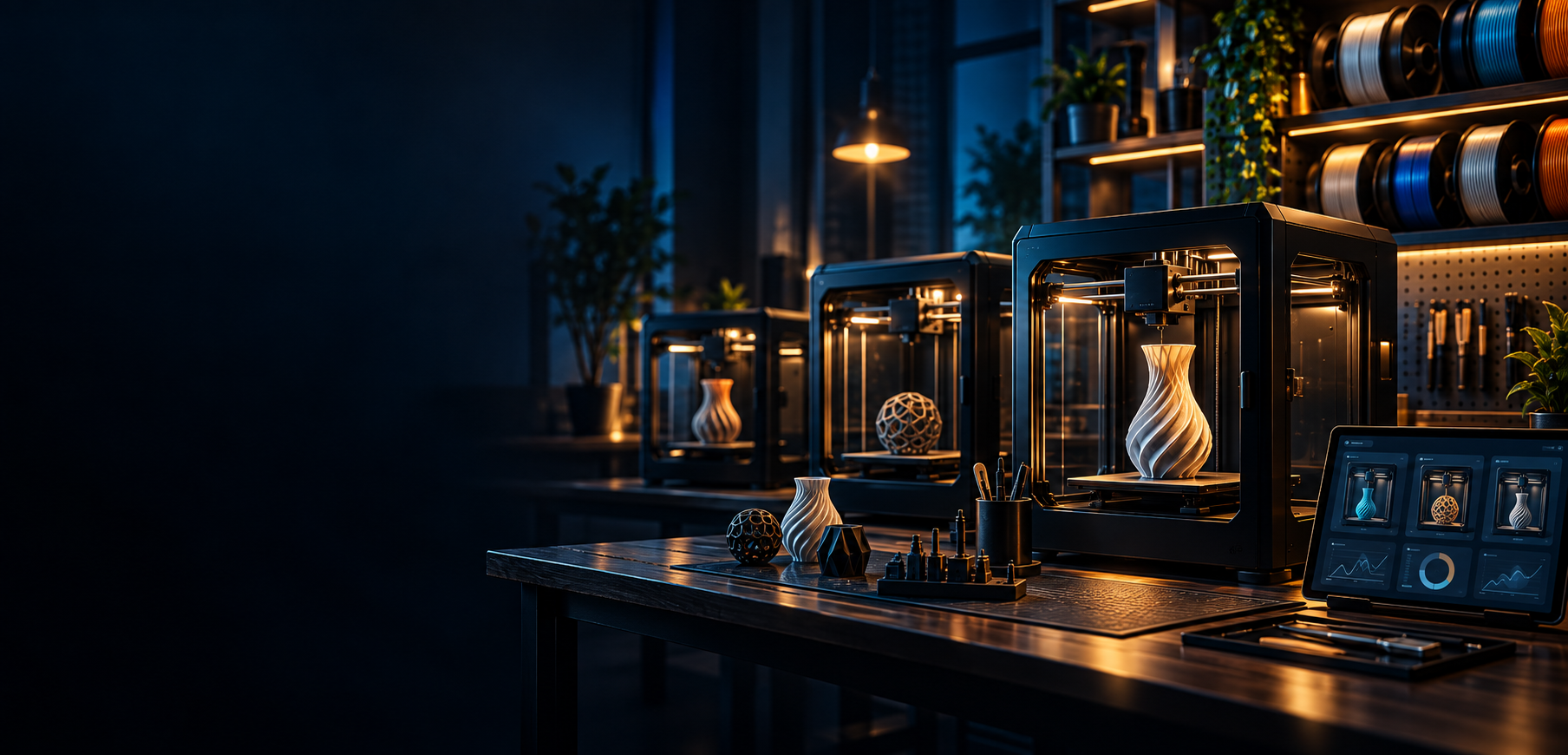
A practical guide for choosing a printer, picking the right materials, understanding real workflow costs, and knowing what to print after the box arrives.
Choosing a 3D printer has never been easier or more confusing. Modern printers are faster, more reliable, and more capable than ever before, yet many makers still struggle with the same questions: Which printer should I buy? Which filament should I use? What should I print first? And how do I keep everything organized as my collection grows? This guide covers the complete 3D printing workflow, from choosing a printer and materials to managing projects, inventory, and finished prints.
Last updated June 2026 / Reviewed by PrintNext Team
Why this guide exists
Choosing a 3D printer has become harder, not easier. New printers launch every year, multicolor systems are becoming common, materials continue to expand, and there are now millions of printable models available online.
Most buyers spend weeks comparing specifications but very little time thinking about the workflow that comes after the printer arrives. Successful makers rarely struggle with the printer alone. They struggle with managing filament, organizing files, deciding what to print, tracking costs, and keeping projects organized over time.
This guide covers both sides of the hobby: choosing the right printer and building a workflow that helps you finish more projects.
Quick recommendations
Availability, bundles, and features change often, so treat this as a practical comparison list rather than a price list. The best printer depends on what you want to make.
| Best for | Printer to compare | Why makers consider it |
|---|---|---|
| First printer | Bambu Lab A1 | Easy setup, modern workflow, and a strong path into multicolor later. |
| Small first printer | Bambu Lab A1 Mini | A compact choice for desk toys, miniatures, small organizers, and learning modern 3D printing. |
| Everyday maker printer | Bambu Lab P1S / P2S family | Reliable enclosed CoreXY printers with optional multi-material and multicolor workflows for everyday printing. |
| Advanced maker printer | Bambu Lab H2D | Designed for advanced makers who want larger build volumes, dual-nozzle capability, high-temperature materials, and workshop-grade fabrication tools. |
| Large build volume | Anycubic Kobra S1 Max Combo | Worth comparing when helmets, cosplay parts, workshop storage, and larger functional projects matter. |
| Value enclosed printer | Elegoo Centauri Carbon | A practical enclosed-printer option for users who want capability without overbuying. |
| Multicolor value option | Elegoo Centauri Carbon 2 | Worth comparing if multicolor printing and overall value are priorities from the start. |
| Open ecosystem | Prusa MK4S / Prusa Core One | Good choices for makers who value documentation, repairability, and long-term control. |
| Tinkerer ecosystem | Creality K1C / K2 series | Popular with makers who enjoy customization, experimentation, and comparing feature-rich machines across different platforms. |
| Multi-tool workshop | Snapmaker | Best considered when CNC, laser, and hybrid fabrication matter as much as 3D printing. |
How to choose
Many buyers focus on speed, nozzles, and build volume. Experienced makers think about reliability, materials, file organization, and the kind of projects they want to finish.
Fast printers are exciting, but the best printer is the one you trust to finish the projects you actually care about.
A 256 mm class printer handles many household projects. Larger beds matter for helmets, workshop parts, cosplay, and large organizers.
Automatic filament changes make signs, logos, gifts, display models, and articulated animals more appealing.
Think about slicer support, replacement parts, storage, filament handling, print history, and how you will organize projects.
Printer fit
The right printer is not always the most advanced one. It is the one that supports your materials, project size, and daily workflow.
| Maker type | What to prioritize |
|---|---|
| Beginner | Reliable setup, auto calibration, simple material support, strong community documentation |
| Functional parts maker | Enclosure, PETG/ASA support, repeatability, good dimensional accuracy |
| Multicolor hobbyist | Reliable filament switching, good waste controls, easy color planning |
| Cosplay and large format | Large build volume, stable bed, good adhesion, predictable long-print behavior |
| Tinkerer | Open settings, repairability, modding community, replacement part access |
| Workshop or professional | Reliability, maintenance plan, material range, workflow tracking, repeatable output |
Build volume
Most makers can create a surprising amount on a medium printer. Large format matters when the objects themselves are large or you want fewer assemblies.
| Size | Typical range | Best for |
|---|---|---|
| Small | 180-220 mm | Miniatures, toys, small organizers, prototypes |
| Medium | Around 256 mm | Most home, desk, and practical prints |
| Large | 300 mm+ | Helmets, cosplay, long organizers, workshop parts |
| Extra large | 350 mm+ | Large assemblies, fixtures, and oversized utility projects |
Filament guide
A great printer using the wrong material can still produce disappointing parts. A modest printer using the right material can produce excellent results.
| Material | Best role | Common projects | What to know |
|---|---|---|---|
| PLA | Best first filament | Decor, toys, organizers, education, multicolor display prints | Easy printing, many colors, great detail, low heat resistance |
| PETG | Best functional starter upgrade | Tool holders, garage storage, brackets, outdoor utility parts | More durable than PLA, more stringing, better toughness |
| TPU | Best flexible material | Phone cases, bumpers, feet, grips, gaskets, shock absorption | Flexible, slower, benefits from tuned extrusion |
| ABS | Best heat-resistant classic | Automotive-style parts, workshop accessories, mechanical components | Needs ventilation and a controlled setup |
| ASA | Best outdoor alternative | Outdoor brackets, signage, garden fixtures, weather-exposed parts | UV resistant, benefits from enclosure and ventilation |
| Carbon fiber blends | Best stiffness upgrade | Jigs, fixtures, rigid functional parts, premium technical prints | Abrasive, usually needs hardened nozzle and compatible printer |
Modern workflow
Most people imagine the process as buying a printer, downloading a model, and pressing print. Real makers quickly build a larger system around their printers, materials, files, and finished projects.
Real costs
First projects
Beginner confidence
Benchy, calibration cube, phone stand, keychain, cable clip
Useful home prints
Drawer organizers, wall hooks, plant labels, battery holders, remote stands
Functional parts
Tool holders, brackets, mounts, shop organization, replacement knobs
Multicolor fun
Dragons, articulated animals, signs, logos, decorative display pieces
PrintNext connects printers, filament inventory, files, costs, recommendations, and print history so makers can spend less time managing folders and more time finishing projects.
FAQ
Most beginners should prioritize reliability, simple setup, good documentation, and easy materials like PLA before chasing advanced features.
Multicolor is worth it if you enjoy signs, gifts, logos, display pieces, articulated animals, or educational models. For purely functional parts, it is useful but less essential.
PLA is still the easiest first filament for most makers because it is forgiving, affordable, and available in many colors.
PETG is generally tougher and more heat resistant than PLA, making it useful for functional parts, outdoor projects, and holders that need more durability.
Not for PLA. Enclosures become more valuable for materials such as ABS, ASA, and some technical blends, and they can help with temperature stability and noise.
Small prints may use less than 50 grams, while larger functional prints, helmets, and multi-part projects can use hundreds of grams.
Start with simple, useful projects that finish quickly and teach printer behavior before moving to larger, support-heavy, or multicolor models.
Entry-level printers can cost a few hundred dollars, while advanced enclosed and multicolor systems can cost significantly more depending on features and materials.
Most desktop 3D printers use relatively little electricity compared to common household appliances. Actual usage depends on print duration, bed temperature, and enclosure heating.
Many makers do, but every printer, environment, and project carries some level of risk. Follow manufacturer recommendations and ensure your setup is safe and properly maintained.
Small prints can finish quickly, while large parts, dense functional prints, and multicolor projects may take many hours. Model size, layer height, infill, supports, and printer speed all matter.
PLA is easier to print and ideal for decorative or indoor projects. PETG offers greater durability, impact resistance, and heat resistance for functional parts.
ABS and ASA are both stronger heat-resistant materials for more demanding parts. ASA is often preferred for outdoor use because it handles UV exposure better.
A dryer is useful if you print moisture-sensitive materials, live in a humid area, or store spools for a long time. Wet filament can cause stringing, popping, weak layers, and rough surfaces.
A medium build volume is enough for many home and functional prints. Larger beds are helpful for helmets, cosplay, workshop storage, long brackets, and fewer multi-part assemblies.
Yes, but the printer is only one part of the business. Successful sellers also manage design rights, quality control, repeatability, shipping, customer expectations, and material costs.
Most makers use a slicer, a place to store model files, and a way to track materials, print settings, costs, and completed projects over time.
A slicer turns a 3D model into printer instructions. It controls settings such as layer height, infill, supports, temperatures, speed, and material changes.
Filament pricing changes by material, brand, color, additives, and spool size. Instead of memorizing a single number, track the spools you own and estimate each project from actual material use.
With maintenance and replacement of wear items such as nozzles, belts, and build surfaces, many printers remain productive for years.
Many knobs, clips, covers, brackets, handles, and organizers can be printed. Avoid parts where heat, load, food safety, or safety-critical failure would create risk.
Avoid huge prints, heavy supports, tight mechanical tolerances, exotic materials, and multi-day jobs until you understand bed adhesion, calibration, slicer settings, and filament behavior.
Related guides
Use these guides to move from printer research into materials, files, first projects, filament tracking, and finished prints.
For a maker choosing between a compact open printer and a larger enclosed printer, list three intended projects first. Check their dimensions, materials, and color needs, then compare the exact machine bundles and required accessories. An enclosure, a material changer, and a larger bed solve different problems; paying for all three only makes sense when your projects use them.
Next step
Save your printers, track filament, estimate costs, and let PrintNext help you decide what is worth printing next.